Learning to Listen Like a Butterfly
When I arrived in Utrecht in the middle of a heatwave, I thought about the elderly, the children, the plants, all those beings we don't hear and who can't immediately speak out. The idea of extinction and threat also loomed large.
When urban infrastructure isn't prepared for the climate crisis, its cracks become visible, its bulges are felt, noises appear, and the sounds of certain life are masked; the same happens with extinction.
When a species disappears from a soundscape, the landscape becomes flatter, standardized, and less diverse.
Extinction is a Noisy Silence
When a species disappears, an invisible web is broken. The silence of a predator becomes the "noise" of its prey overpopulating; the silence of a pollinator transforms into the decline of forests. Nature speaks through these absences.
Which species might be endangered by these climate anomalies?
What does such extinction sound like?
It was during this exploration that I discovered many plant, animal, and human species that shared the same threats, not for the same reasons or with the same problems, but rather due to a structural way of understanding and living life. The weeping of a woman unable to find an affordable home in Utrecht, the disappearance of the Whimbrel due to habitat fragmentation, the decline in the Korenwolf population caused by intensive agriculture, wild bees stressed by climate change, and finally, the Thecla Batelous butterfly due to the lack of suitable blackthorn bushes for its survival.
In general, extinction sounds like an ecosystem populated more by opportunistic generalists like foxes, magpies, wild boars, and pigeons than by specialists adapted to specific ecosystems. Extinction is not silence, but rather a simplified and monopolistic sound.
Sound Conservation, Protecting the Invisible Network
What these signs of extinction in human and non-human ecosystems suggest is that to avoid extinction, we must not only protect or conserve specific places but rather stimulate the network that sustains all these lives. It is the journey, its stops, and the lives that comprise it that will allow life to continue. Another example, besides birds, that has these close relationships with other living beings is butterflies.
In particular, the Thecla betalus, which has recently developed a territorial connection with peri-urban gardens, makes it a perfect species for understanding and exploring the tension between what humans have built as a refuge—our cities—and the other beings that inhabit non-urban environments.
Without Butterflies There is No Paradise
Butterflies are probably one of the most emblematic species when we talk about idyllic landscapes. In fact, they are considered a bioindicator species for measuring the health of ecosystems; greater butterfly diversity is a good sign for that ecosystem. It helps us measure our progress in reconciling with the ecosystem that sustains us. However, we have been witnessing a decline in their population for many years. In Europe alone, between 1991 and 2023, the EU grassland butterfly population halved.
Sonic Gentrification Interspecies
The decline in butterflies cannot be attributed to a single cause, ranging from the removal of hedges and small shrubs to urbanization and road clearing. The use of herbicides and the "cleaning" of field margins, rural roads, and embankments leads to the disappearance of spontaneous vegetation where hawthorn and other nectar-producing plants grow.
All these host plants—the places where butterflies lay their eggs and larvae find food to continue their life cycle—are crucial.
The tension here is quite clear, especially regarding the "cleaning or alteration of a natural area to make it visually more appealing to other species, such as humans, and to allow it to coexist with other species that don't interfere with its aesthetic interests—an interspecies gentrification. That sonic and gentrifying displacement."
The Thecla Betulae
In the Netherlands, the decline of the beech sleedoornpage butterfly (Thecla betulae) is primarily due to the loss and mismanagement of its specific habitat. The species depends almost exclusively on blackthorn (Prunus/Crataegus) trees for egg-laying and larval development.
Furthermore, the beech sleedoornpage overwinters as an egg on the branches of these shrubs, so pruning and clearing carried out in winter or early spring directly destroy the egg masses and further fragment already highly localized populations.
Soundscapes Heard by the Thecla Betulae
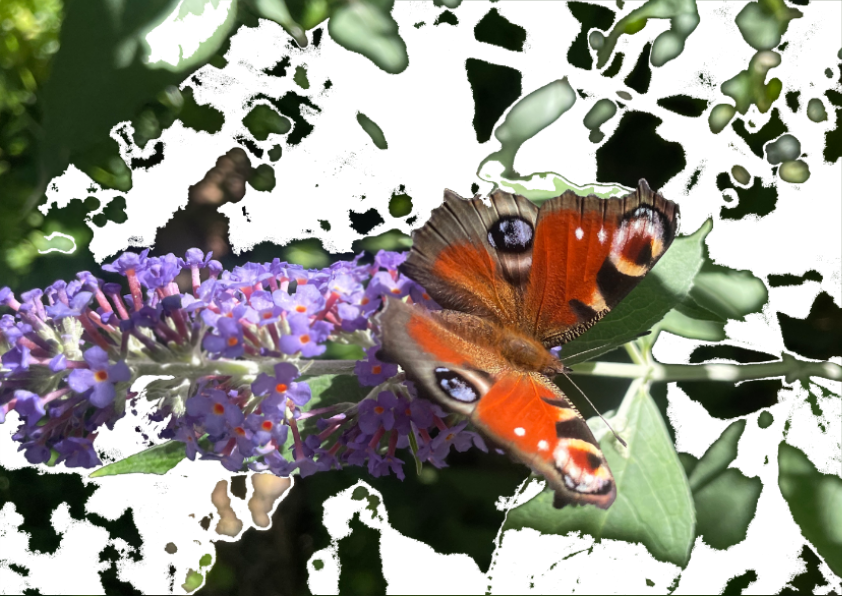
The betula butterfly (Thecla betulae) is undoubtedly one of the most emblematic butterflies of the Netherlands. When I first encountered it, I was struck by its beautiful relationship with the surrounding ecosystem. It has a sedentary lifestyle, using various plants for nesting, food, and shelter. The blackthorn is its refuge, its mother plant. It protects it, along with the help of ants that guard the larvae. From the caterpillar stage, they use sound to stay safe.
They listen to protect themselves.
This species is increasingly found in gardens and peri-urban areas. It is primarily found in scrubland along forest edges, road and railway embankments, sunken paths, and cultivated fields. Furthermore, the species can be found in urban environments where it uses blackthorn scrub in parks and isolated plum trees in gardens. The blackthorn trees it uses should be regularly rejuvenated through extensive grazing or regular pruning.
What Does a Butterfly Hear?
Butterflies don't have ears like humans, but recent research has found something very similar: organs composed of tympanic membranes. Both are tuned over a broad range of 1 to 20 kHz, with optimal frequencies between 1 and 3 kHz, but NIII is significantly more sensitive than NII. The compound action potentials (PACs) of both branches increase their amplitudes and first-peak areas in response to higher sound levels. NII and NIII differed in their suprathreshold PAC responses to sound frequencies, with stronger responses at 1–3 kHz and 4–6 kHz for NIII and NII, respectively.
The results of this research indicate that butterflies are capable of discriminating amplitude and frequency. Both auditory branches responded to recordings of raptor flight and calls. The study proposes that butterfly ears, like those of many vertebrate prey such as some rabbits and lizards, function primarily to assess the risk of being attacked by predators.
The shape of the membrane determines what can be heard (Frequency-selective vibration)
- Low frequencies (low energy): The mathematical model shows that only the periphery of the elliptical membrane vibrates.
- High frequencies (high energy): The entire plate resonates simultaneously, mechanically dragging the central dome.
This range of low frequencies coincides precisely with the sounds birds produce in flight (wing flapping, air movement). Therefore, researchers propose that these ears may have evolved to detect approaching avian predators, rather than nocturnal attackers like bats. This is known as "auditory regression": when a function becomes less necessary, the organ can become less specialized over time (something that has been observed in other insects that changed their habits).
Let's Prevent Auditory Regression
Auditory regression is a phenomenon that occurs in certain insects, reducing their hearing capacity because they don't need it. In a dark and crisis-ridden world, we need to hear to feel safe. We need to develop new ways of hearing to confront the climate crisis.
Vogel's Organ
An exercise in interspecies acoustic empathy.
This device is designed to make us feel and encourage us to reflect on our relationship with other species, our habits and rituals in the territories we inhabit and traverse.
How would you live life if you only heard the frequencies of butterflies?
Manifesto of Interspecies Acoustic Empathy
Tuning Our Listening as a Weapon of Resistance
For a butterfly, listening is a critical tool for preventing danger. It has a keen awareness of its predators and is extremely attuned to the flapping of birds' wings, human footsteps, and other sounds that could endanger its life.
In the case of humans, listening is not only related to physical vibrations, but above all to political and economic ones. Tuning our listening as an act of resistance refers to perceiving the signals of other economic and political entities that can prey on our environment. Far-right parties, for example, or a trending topic on social media. The normalization of something commonplace and familiar that, in the long run, can cause great harm.
What does tuning your listening to resist in your environment mean to you?
It means having a call to our allies
When a butterfly is a caterpillar, it knows it is more vulnerable, which is why it needs allies to protect itself from its predators. In this case, there's a correspondence with ants where the caterpillar provides them with information about the tree's nectar. In this way, the ants approach and care for the caterpillars.
What call do you identify right now with your other allies for protection?
Listening as protection
Listening to each other to protect ourselves. Just as butterflies in their different life stages use their senses to protect themselves, we as humans should be attentive to a kind of listening that allows us to protect ourselves and others. This is about creating more honest, transparent, and empathetic listening.
How do you protect those you love most through listening?
Recognizing frequencies and amplitude
A butterfly doesn't just hear that something is moving: it knows how to read its pitch and volume, and from there calculates distance and size. Frequency and amplitude are its compass. Translated to human terms, this could be the ability to distinguish between a threat that is just beginning to stir on the horizon—an idea that is tentatively circulating—and one that is already upon us, amplified, normalized, almost impossible to ignore. Sharpening our hearing is also sharpening our judgment: knowing how close and how large what is approaching is, before it is too late to name it.
How do you distinguish what generates the most noise for you?
What is noise for some is vitality for others
Butterflies with hearing perceive low frequencies best—the beating of a wing, the passage of a predator—and barely register human speech, too high-pitched for their sensitivity. Each species is calibrated for what saves its life, not for what is interesting to another.
The same is true for humans: what for some is background noise—a news story that is repeated, a community shouting something that cannot be heard elsewhere—for others is the most urgent signal of all. Truly listening, then, means stepping outside our own frequency and paying attention to the frequency of those who perceive dangers we don't even register.
How do you listen to the most vulnerable?
The refinement of our listening as a weapon of resistance
A butterfly doesn't listen out of curiosity. It listens because its life depends on knowing, before it's too late, whether the moving air is wind or a bird falling on it. Every nearby flapping of wings, every human footstep on the grass, is recorded on a membrane the size of a seed.
We, too, should listen like this. Not only to physical sound, but also to the sounds that travel in discourses, in trends, in silences that become habitual. There are predators that don't flap their wings: they arrive disguised as a repeated phrase, a political party that promises order, a post shared without thinking. Refining our hearing is learning to distinguish the wind from the approaching wing.
What does it mean for you to refine your listening in order to resist and regenerate your environment?